
Georgia Locksmith Licensing Laws Explained
Georgia doesn’t require a statewide locksmith license — a fact every Georgia locksmith and locksmith GA searcher should know, and one that explains most of the scam problems Macon residents run into when searching for locksmith help.
This applies whether you’re hiring a locksmith in Macon or anywhere else across Middle Georgia — always ask for ID and a written estimate before work begins.
Is a Locksmith License Required in Georgia?
No. Unlike states such as Texas, Louisiana, or California, Georgia does not have a state licensing board that regulates or certifies locksmiths. There’s no exam, no state-issued license number, and no state agency tracking who is or isn’t qualified to do locksmith work.
This matters more than it might seem. In states with licensing requirements, a homeowner can verify a locksmith’s credentials through a state database before letting them into their home or car. In Georgia, that verification layer simply doesn’t exist — which is exactly what makes it easy for out-of-state dispatch operations to claim to be “licensed and insured” with nothing to back it up.
Why This Enables the Bait-and-Switch Problem
Without a state licensing requirement, anyone can put up a website, buy Google ads with a local-sounding phone number, and claim to be a Macon locksmith — regardless of training, background, or actual location. This is the root cause behind the pattern we see across Macon searches: low phone quotes that triple once a technician arrives, contractors with no real accountability, and companies that vanish and reappear under a new name when reviews turn negative.
What You Should Look for Instead of a State License
Georgia locksmith licensing laws provide no licensing safety net, so the responsibility shifts to you as the consumer — and to legitimate locksmith companies to prove trustworthiness through other means:
- Bonding and insurance — ask for proof, and expect it to be provided without hesitation
- A real, verifiable local address — not just a phone number with a local area code
- Technician identification — ask whether the company will identify the technician they send into your home
- Genuine local reviews — with enough detail and consistency to look real, not vague 5-star ratings with no substance
- An identifiable technician — someone accountable, not a subcontractor from an unrelated network
Do Georgia Locksmith Licensing Laws Vary by City?
Some municipalities have local business licensing requirements that apply to any business operating within city limits — but these are general business registration requirements, not locksmith-specific trade licensing or competency testing. They don’t verify a locksmith’s actual skill or trustworthiness the way a trade-specific license would. State-level business registration is a separate matter, handled by the Georgia Secretary of State’s Corporations Division.
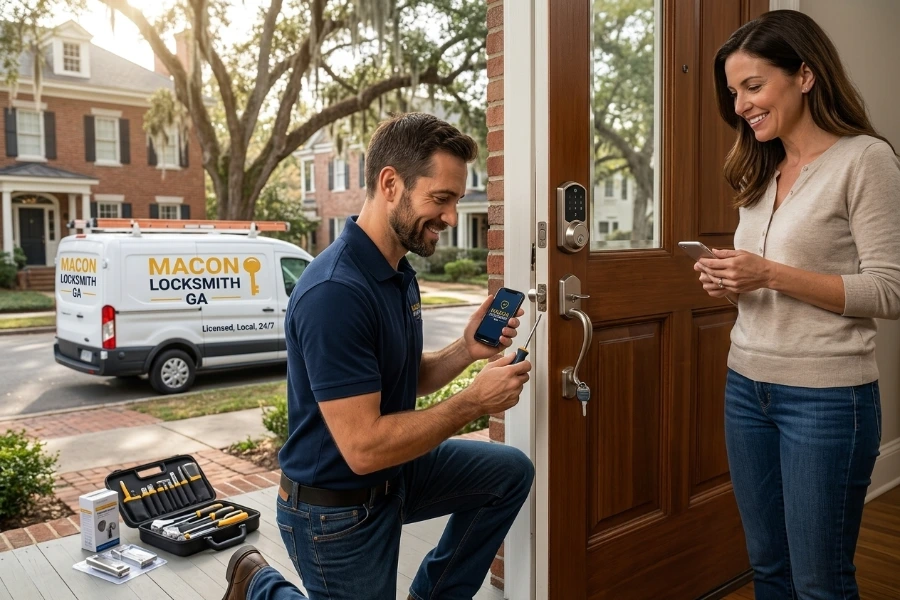
What “Bonded and Insured” Actually Protects You From
- Bonding provides a financial guarantee if a technician fails to complete a job as promised or causes damage through negligence.
- Insurance covers accidental property damage that can occur during a lock installation, rekey, or emergency entry.
- Technician identification means you know who is coming to your home or business, rather than receiving a stranger from a subcontractor pool with no accountability.
Ask any locksmith you’re considering hiring — in Macon or anywhere — whether they carry this coverage and whether they’ll provide documentation. A legitimate company will answer without hesitation. If they dodge the question, that’s your answer.
How to Verify Before You Hire
- Ask for proof of bonding and insurance directly — a real company can produce this immediately.
- Confirm the technician is a direct employee, not a subcontractor from an unrelated dispatch network.
- Check for a real local address and an identifiable technician, not just a phone number with a local area code.
For a full breakdown of common scam tactics targeting Macon residents, see How to Spot a Fake Locksmith in Macon, GA.
Georgia Locksmith Licensing Laws in Practice: Homes, Rentals, Businesses and Cars
Because Georgia does not license locksmiths at the state level, what you check depends on the job. These are the practical questions to ask for the most common situations in Macon-Bibb County.
- Your home: a written quote, the company’s name and local address, and proof of insurance before any drilling.
- A rental: check your lease first. Landlords should keep a record of every lock change between tenants.
- A business: an itemized invoice with the company name, and a plan for who holds which keys, such as a master key system.
- Your car: a legitimate locksmith will ask for ID and proof of ownership before opening the car or making a key.
If a locksmith skips these steps, or refuses to give a price before arriving, treat it as a warning sign and read how to choose a locksmith in Macon.
Frequently Asked Questions
If Georgia doesn’t license locksmiths, how do I know who to trust?
Under Georgia locksmith licensing laws, there is no state list to check, so focus on bonding, insurance, a verifiable local address, and genuine reviews — see our full guide on spotting fake locksmiths for the complete checklist.
Is it illegal to work as a locksmith in Georgia without a license?
Since there’s no state licensing requirement, there’s no license to operate without. This is precisely the gap that allows uncertified, low-accountability operators into the market alongside legitimate local businesses.
Are locksmiths required to carry insurance in Georgia?
Not by state mandate. Insurance and bonding are chosen by reputable companies to protect customers and build trust — not because the state requires it.